

Turbid Water in Irbid… A Growing Problem Burdening Citizens and Threatening Their Lives


Amman – A recent investigative report highlights a silent but worsening crisis in Irbid Governorate, where drinking water in several areas has turned turbid and unsafe for domestic use. This forces thousands of families to seek costly alternatives outside the official water supply network.اضافة اعلان
The investigation, based on testimonies from residents, experts, and expenditure records, shows that the effects of turbid water go beyond health concerns. It imposes direct and indirect economic costs, including purchasing bottled water and tanker deliveries, damage to household appliances, reduced lifespan of devices, and ongoing maintenance and repair expenses.
In one of Jordan’s most densely populated governorates, the investigation reveals a gap between service costs and quality, due to an aging water network, high water loss, and official responses that have yet to produce tangible improvements in residents’ daily lives.
Residents have endured turbid water for years, a problem that extends beyond taste or color, directly affecting health and household appliance efficiency. The turbidity stems from suspended particles in the water, which clog filters and pipes, reduce the efficiency of heaters, washing machines, and dishwashers, leading to higher electricity consumption and faster appliance wear.
The Path of Turbidity
When Irbid residents open their taps, they often encounter murky water filled with fine particles, making daily use a struggle. Turbidity is not just an unpleasant appearance or taste; it signals deeper issues such as nitrate and ammonia contamination and mineral deposits that interfere with household devices. Solar heaters, washing machines, and dishwashers face daily threats, increasing household expenses and shortening appliance lifespans.
Beyond health issues, turbid water creates financial and technical burdens, forcing families to spend heavily on maintenance or replacing appliances prematurely due to unsafe long-term water use. The problem reflects broader challenges like sewage system weaknesses and excessive fertilizer use that contaminate and deplete groundwater, according to the Ministry of Water and Irrigation’s April 2025 report, Integrated Management of Groundwater Resources.
Stories from Homes
Emad Jabr, a resident of Irbid’s 30th Street, struggles with his washing machine, which has required repairs four times in a year due to salt buildup in pipes and the drum. Hussein Ismail, from the Eastern District, faces similar issues with water heaters, whose lifespans are far shorter than devices in Amman despite regular maintenance. Firas Hassan installed a solar heater to reduce electricity bills but found mineral deposits in less than two years, reducing hot water flow and efficiency.
Official Data Confirms the Issue
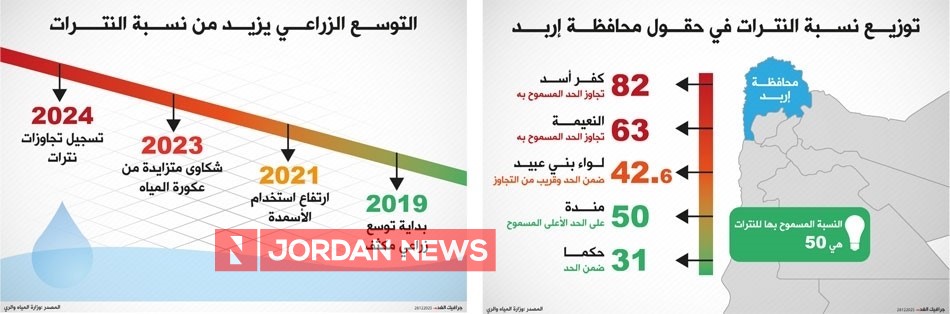
Government data, including the April 2025 report Nitrate Pollution in Jordan – Sources and Recommended Measures, shows that Irbid is among the most affected areas by nitrate contamination in groundwater, due to high population density, unregulated agricultural expansion, and weak sewage services. Field analyses revealed nitrate concentrations in some wells exceeding Jordanian drinking water standards, with levels in Kafr Asad reaching 16–82 mg/L, in Naima 63 mg/L, and in Manda 19–50 mg/L.
The main causes include sewage leaks, overuse of chemical and organic fertilizers, olive mill runoff, and declining groundwater levels of 5–8 meters annually, which concentrate pollutants and threaten household appliances.
A Hidden Enemy
Engineer Dalal Mohammed explains that ammonia and nitrate buildup corrodes metals and rubber seals in pumps and pipes, while scaling deposits reduce heater efficiency and increase energy consumption. Turbidity clogs fine filters and pipes, affecting washing machines and dishwashers, and diminishes cleaning performance. Maintenance expert Omar Al-Omari estimates that 30% of water-related appliance failures are directly due to poor water quality, while the rest are from misuse, power outages, or lack of routine maintenance.
Financial Impact on Families
Repeated maintenance costs have become a financial burden. Hussein Ismail sometimes spends half the appliance’s value in one year for internal cleaning or part replacement. Emad Jabr notes that installing home water filters increases costs further, with filter cartridges costing 25 JOD per month instead of every three to four months. Overall filter costs range between 125–185 JOD.
Al-Omari emphasizes that the solution requires improving water quality at the source, educating residents on routine maintenance, and installing proper filtration before appliances. Modern devices are designed to operate efficiently with clean water, stable electricity, and regular maintenance; otherwise, malfunctions persist regardless of appliance type or price.
Before It’s Too Late
The Ministry of Water and Irrigation’s report recommends expanding advanced sewage services, preventing treated wastewater from contaminating drinking water sources, reassessing polluted well locations, relocating some wells if necessary, and including groundwater protection zones in Irbid’s urban planning. Nitrate levels should be monitored every six months to ensure safe water supply.
Engineer Dalal Mohammed stresses that rising nitrate and ammonia levels, alongside turbidity and scaling, directly impact household appliances, reducing efficiency and lifespan while increasing energy use. Improving water quality is thus both a health and financial necessity.
Officials’ Perspective
Omar Salameh, spokesperson for the Ministry of Water and Irrigation, confirms that water quality in Jordan is a “red line,” and all treated water reaching residents is 100% safe, subject to strict laboratory testing. He notes that complaints about turbidity often result from poor household tank maintenance or broken pipes, which are promptly repaired. Long-term plans to expand sewage services until 2040 exist but rely on international funding, while unplanned urban growth hinders implementation.
Yarmouk Water Company spokesperson Moataz Ubaidat confirms that all water sources undergo laboratory testing before distribution and meet Jordanian drinking water standards.
Despite these assurances, turbid water contaminated with nitrates and ammonia in Irbid remains a dual burden on residents—healthwise and financially. Household appliances suffer directly, repeated maintenance costs accumulate quickly, and sustainable source-level solutions are needed to ensure safe water. Addressing the issue requires real collaboration between authorities and consumers to improve water quality, enhance sewage services, and monitor water standards regularly. Failure to act will exacerbate appliance failures, increase household expenses, and potentially harm thousands of families, making water quality improvement an urgent priority.
By Dima Mahboubah – Al-Ghad
The investigation, based on testimonies from residents, experts, and expenditure records, shows that the effects of turbid water go beyond health concerns. It imposes direct and indirect economic costs, including purchasing bottled water and tanker deliveries, damage to household appliances, reduced lifespan of devices, and ongoing maintenance and repair expenses.
In one of Jordan’s most densely populated governorates, the investigation reveals a gap between service costs and quality, due to an aging water network, high water loss, and official responses that have yet to produce tangible improvements in residents’ daily lives.
Residents have endured turbid water for years, a problem that extends beyond taste or color, directly affecting health and household appliance efficiency. The turbidity stems from suspended particles in the water, which clog filters and pipes, reduce the efficiency of heaters, washing machines, and dishwashers, leading to higher electricity consumption and faster appliance wear.
The Path of Turbidity
When Irbid residents open their taps, they often encounter murky water filled with fine particles, making daily use a struggle. Turbidity is not just an unpleasant appearance or taste; it signals deeper issues such as nitrate and ammonia contamination and mineral deposits that interfere with household devices. Solar heaters, washing machines, and dishwashers face daily threats, increasing household expenses and shortening appliance lifespans.
Beyond health issues, turbid water creates financial and technical burdens, forcing families to spend heavily on maintenance or replacing appliances prematurely due to unsafe long-term water use. The problem reflects broader challenges like sewage system weaknesses and excessive fertilizer use that contaminate and deplete groundwater, according to the Ministry of Water and Irrigation’s April 2025 report, Integrated Management of Groundwater Resources.
Stories from Homes
Emad Jabr, a resident of Irbid’s 30th Street, struggles with his washing machine, which has required repairs four times in a year due to salt buildup in pipes and the drum. Hussein Ismail, from the Eastern District, faces similar issues with water heaters, whose lifespans are far shorter than devices in Amman despite regular maintenance. Firas Hassan installed a solar heater to reduce electricity bills but found mineral deposits in less than two years, reducing hot water flow and efficiency.
Official Data Confirms the Issue
Government data, including the April 2025 report Nitrate Pollution in Jordan – Sources and Recommended Measures, shows that Irbid is among the most affected areas by nitrate contamination in groundwater, due to high population density, unregulated agricultural expansion, and weak sewage services. Field analyses revealed nitrate concentrations in some wells exceeding Jordanian drinking water standards, with levels in Kafr Asad reaching 16–82 mg/L, in Naima 63 mg/L, and in Manda 19–50 mg/L.
The main causes include sewage leaks, overuse of chemical and organic fertilizers, olive mill runoff, and declining groundwater levels of 5–8 meters annually, which concentrate pollutants and threaten household appliances.
A Hidden Enemy
Engineer Dalal Mohammed explains that ammonia and nitrate buildup corrodes metals and rubber seals in pumps and pipes, while scaling deposits reduce heater efficiency and increase energy consumption. Turbidity clogs fine filters and pipes, affecting washing machines and dishwashers, and diminishes cleaning performance. Maintenance expert Omar Al-Omari estimates that 30% of water-related appliance failures are directly due to poor water quality, while the rest are from misuse, power outages, or lack of routine maintenance.
Financial Impact on Families
Repeated maintenance costs have become a financial burden. Hussein Ismail sometimes spends half the appliance’s value in one year for internal cleaning or part replacement. Emad Jabr notes that installing home water filters increases costs further, with filter cartridges costing 25 JOD per month instead of every three to four months. Overall filter costs range between 125–185 JOD.
Al-Omari emphasizes that the solution requires improving water quality at the source, educating residents on routine maintenance, and installing proper filtration before appliances. Modern devices are designed to operate efficiently with clean water, stable electricity, and regular maintenance; otherwise, malfunctions persist regardless of appliance type or price.
Before It’s Too Late
The Ministry of Water and Irrigation’s report recommends expanding advanced sewage services, preventing treated wastewater from contaminating drinking water sources, reassessing polluted well locations, relocating some wells if necessary, and including groundwater protection zones in Irbid’s urban planning. Nitrate levels should be monitored every six months to ensure safe water supply.
Engineer Dalal Mohammed stresses that rising nitrate and ammonia levels, alongside turbidity and scaling, directly impact household appliances, reducing efficiency and lifespan while increasing energy use. Improving water quality is thus both a health and financial necessity.
Officials’ Perspective
Omar Salameh, spokesperson for the Ministry of Water and Irrigation, confirms that water quality in Jordan is a “red line,” and all treated water reaching residents is 100% safe, subject to strict laboratory testing. He notes that complaints about turbidity often result from poor household tank maintenance or broken pipes, which are promptly repaired. Long-term plans to expand sewage services until 2040 exist but rely on international funding, while unplanned urban growth hinders implementation.
Yarmouk Water Company spokesperson Moataz Ubaidat confirms that all water sources undergo laboratory testing before distribution and meet Jordanian drinking water standards.
Despite these assurances, turbid water contaminated with nitrates and ammonia in Irbid remains a dual burden on residents—healthwise and financially. Household appliances suffer directly, repeated maintenance costs accumulate quickly, and sustainable source-level solutions are needed to ensure safe water. Addressing the issue requires real collaboration between authorities and consumers to improve water quality, enhance sewage services, and monitor water standards regularly. Failure to act will exacerbate appliance failures, increase household expenses, and potentially harm thousands of families, making water quality improvement an urgent priority.
By Dima Mahboubah – Al-Ghad
NEWS RELATED TO