

National Conference Recommends Reforming the Kafala System in Jordan

- +
- -


A national conference held in Amman on Tuesday concluded with a set of legislative and procedural recommendations aimed at dismantling the elements of the kafala system as applied in practice within Jordan’s labor market, and at strengthening protections for migrant workers in line with international labor standards and best practices. The proposed reforms seek to reduce the risks of exploitation and forced labor and to improve Jordan’s standing on the Modern Slavery Index.اضافة اعلان
These recommendations were issued at the conclusion of the conference titled “Reforming Policies Governing the Employment of Migrant Workers in Jordan,” organized by the Phenix Center for Economic & Informatics Studies in cooperation with the Justice Center for Legal Aid, with the support of Walk Free, and with the participation of representatives of international organizations, legal experts, civil society organizations, and official institutions.
Participants stressed the need to reinforce migrant workers’ effective right to resign and change employers through a clear and transparent mobility mechanism overseen by the competent authorities, without requiring sponsor approval. They also called for special safeguards enabling workers to change employers in cases of serious violations or labor disputes.
The recommendations further urged reforming the framework governing “absconding/runaway” reports by replacing existing terminology and procedures with a neutral legal framework that ensures prior administrative verification and the right of the worker to be heard. Measures to prevent malicious reports—through evidentiary requirements and deterrent penalties—were emphasized, alongside the establishment of digital, multilingual reporting channels.
Participants underscored the importance of separating labor disputes from administrative enforcement tools, including halting administrative detention and deportation while labor cases are under review, and ensuring that workers do not automatically lose their legal status merely due to a dispute with an employer. They also called for guaranteeing the right to effective judicial appeal against deportation and removal decisions, suspending enforcement until a final ruling is issued, clearly defining grounds for removal, separating appeals against detention from removal, and facilitating litigation procedures by exempting appeals from fees and treating them as urgent cases.
With regard to access to justice, the conference outcomes emphasized strengthening legal aid services and ensuring the availability of interpretation and legal information at all stages of litigation. Participants recommended launching national, multilingual awareness programs to inform migrant workers of their rights and available remedies. They also called for establishing expedited judicial pathways for minor labor disputes and cases related to resignation or change of employer, and for revitalizing labor mediation mechanisms to reduce delays and curb abuse. Additional recommendations included developing dedicated legislation for the Wage Authority to define procedures for handling complaints, enforcement, and appeals on an expedited basis, as well as expanding its geographic reach beyond Amman to ensure access for workers in densely populated and remote areas.
The conference was opened by Ahmad Awad, Director of the Phenix Center, who emphasized that reforming policies governing migrant labor is a key entry point for strengthening the rule of law and fairness in the labor market. He stressed that the objective is not to weaken oversight or harm employers, but rather to build a more transparent and balanced system that safeguards fundamental rights and prevents exploitation.
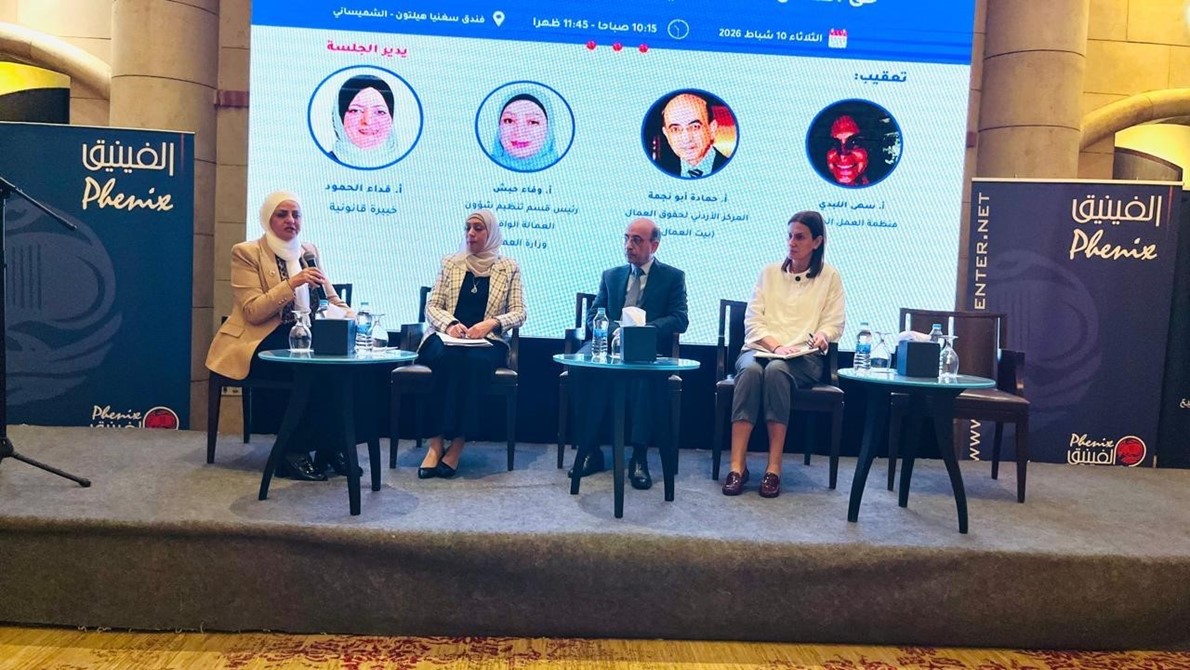
The first session provided an overview of the legislative and policy framework governing migrant labor and featured the presentation of a policy paper on migrant workers’ right to resign and change employers, delivered by Ahmad Awad. The session was moderated by Fidaa Al-Hammoud, former President of the Legislation and Opinion Bureau at the Prime Ministry, and included contributions from Suha Al-Labadi, representing the International Labour Organization, Hamadeh Abu Najmeh, an expert on international labor standards, and Wafaa Habbash, Director of the Migrant Workers Directorate at the Ministry of Labor.
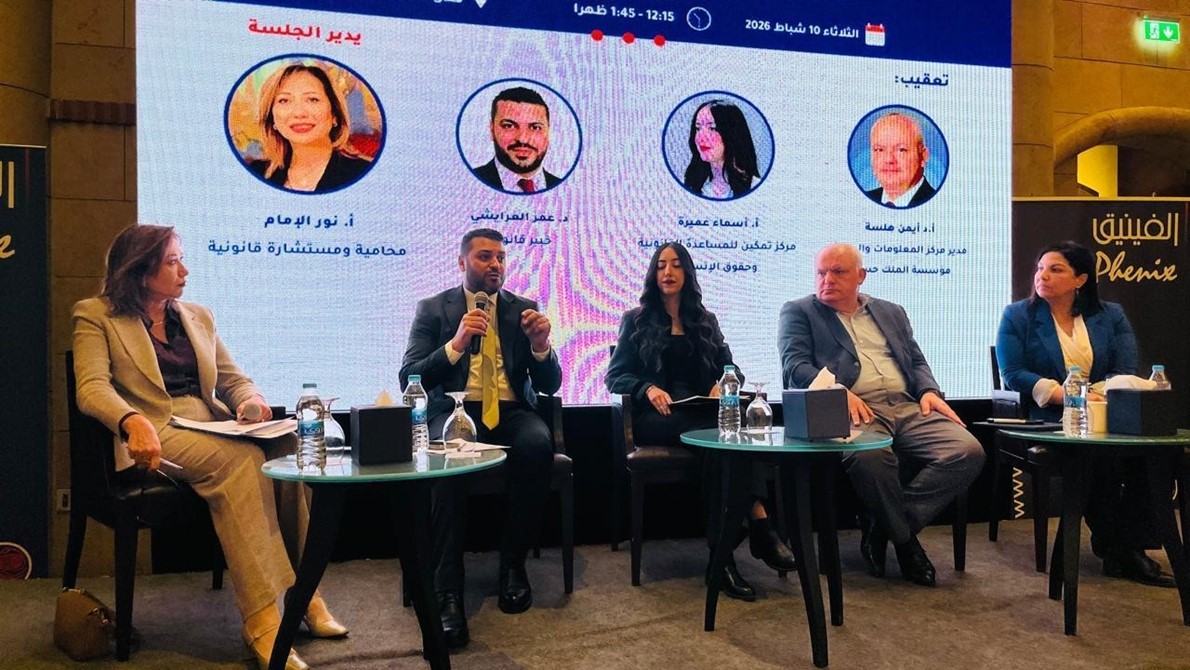
In the second session, moderated by lawyer and legal expert Nour Al-Imam, Hadeel Abdelaziz presented two policy papers addressing migrant workers’ access to justice and the impact of the relationship between work permits and residency permits on migrants’ legal status. Commentaries were provided by Dr. Ayman Halseh, Professor of International Law and Director of the Information and Research Center at the King Hussein Foundation, Asmaa Omeira, lawyer at Tamkeen Center for Legal Aid and Human Rights, and Dr. Omar Al-Araisha, an expert in labor legislation.
Participants concluded that addressing the practical application of kafala-like arrangements is a necessary step toward reducing indicators of exploitation and forced labor, and toward creating a more equitable working environment for migrant workers—one that aligns with international standards and enhances Jordan’s image and ranking on relevant global indices.
These recommendations were issued at the conclusion of the conference titled “Reforming Policies Governing the Employment of Migrant Workers in Jordan,” organized by the Phenix Center for Economic & Informatics Studies in cooperation with the Justice Center for Legal Aid, with the support of Walk Free, and with the participation of representatives of international organizations, legal experts, civil society organizations, and official institutions.
Participants stressed the need to reinforce migrant workers’ effective right to resign and change employers through a clear and transparent mobility mechanism overseen by the competent authorities, without requiring sponsor approval. They also called for special safeguards enabling workers to change employers in cases of serious violations or labor disputes.
The recommendations further urged reforming the framework governing “absconding/runaway” reports by replacing existing terminology and procedures with a neutral legal framework that ensures prior administrative verification and the right of the worker to be heard. Measures to prevent malicious reports—through evidentiary requirements and deterrent penalties—were emphasized, alongside the establishment of digital, multilingual reporting channels.
Participants underscored the importance of separating labor disputes from administrative enforcement tools, including halting administrative detention and deportation while labor cases are under review, and ensuring that workers do not automatically lose their legal status merely due to a dispute with an employer. They also called for guaranteeing the right to effective judicial appeal against deportation and removal decisions, suspending enforcement until a final ruling is issued, clearly defining grounds for removal, separating appeals against detention from removal, and facilitating litigation procedures by exempting appeals from fees and treating them as urgent cases.
With regard to access to justice, the conference outcomes emphasized strengthening legal aid services and ensuring the availability of interpretation and legal information at all stages of litigation. Participants recommended launching national, multilingual awareness programs to inform migrant workers of their rights and available remedies. They also called for establishing expedited judicial pathways for minor labor disputes and cases related to resignation or change of employer, and for revitalizing labor mediation mechanisms to reduce delays and curb abuse. Additional recommendations included developing dedicated legislation for the Wage Authority to define procedures for handling complaints, enforcement, and appeals on an expedited basis, as well as expanding its geographic reach beyond Amman to ensure access for workers in densely populated and remote areas.
The conference was opened by Ahmad Awad, Director of the Phenix Center, who emphasized that reforming policies governing migrant labor is a key entry point for strengthening the rule of law and fairness in the labor market. He stressed that the objective is not to weaken oversight or harm employers, but rather to build a more transparent and balanced system that safeguards fundamental rights and prevents exploitation.
The first session provided an overview of the legislative and policy framework governing migrant labor and featured the presentation of a policy paper on migrant workers’ right to resign and change employers, delivered by Ahmad Awad. The session was moderated by Fidaa Al-Hammoud, former President of the Legislation and Opinion Bureau at the Prime Ministry, and included contributions from Suha Al-Labadi, representing the International Labour Organization, Hamadeh Abu Najmeh, an expert on international labor standards, and Wafaa Habbash, Director of the Migrant Workers Directorate at the Ministry of Labor.
In the second session, moderated by lawyer and legal expert Nour Al-Imam, Hadeel Abdelaziz presented two policy papers addressing migrant workers’ access to justice and the impact of the relationship between work permits and residency permits on migrants’ legal status. Commentaries were provided by Dr. Ayman Halseh, Professor of International Law and Director of the Information and Research Center at the King Hussein Foundation, Asmaa Omeira, lawyer at Tamkeen Center for Legal Aid and Human Rights, and Dr. Omar Al-Araisha, an expert in labor legislation.
Participants concluded that addressing the practical application of kafala-like arrangements is a necessary step toward reducing indicators of exploitation and forced labor, and toward creating a more equitable working environment for migrant workers—one that aligns with international standards and enhances Jordan’s image and ranking on relevant global indices.
NEWS RELATED TO