

73.2% of Jordan’s Exports Last Year Went to Countries with Free Trade Agreements


Data released by the Amman Chamber of Commerce shows that countries with which Jordan has free trade agreements accounted for 73.2% of the Kingdom’s total exports last year, highlighting the importance of these agreements in strengthening Jordan’s export presence in international markets.اضافة اعلان
According to statistical data from the chamber, Jordan’s exports to countries with trade agreements reached 7.047 billion dinars in 2025, compared with 6.553 billion dinars in 2024.
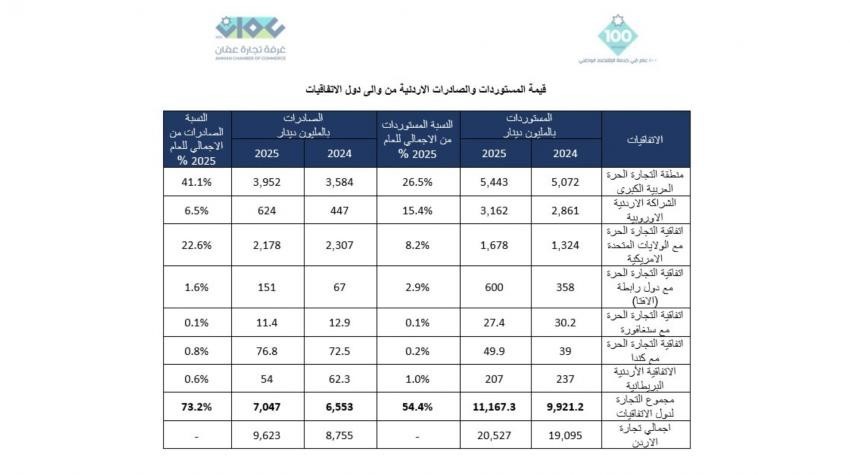
The data also indicated that these partner countries accounted for 54.4% of Jordan’s total imports in 2025.
Based on statistics compiled from multiple official sources, Jordan’s imports from countries with which it has trade agreements rose to 11.167 billion dinars in 2025, compared with 9.921 billion dinars in 2024.
Overall, the Kingdom’s total trade last year reached 9.623 billion dinars in exports and 20.527 billion dinars in imports.
Jordan has signed numerous free trade agreements with global economic blocs and individual countries. Among the most notable are the Greater Arab Free Trade Area established in 1978, the free trade agreement with the United States that came into force in 2001, and the EU–Jordan Association Agreement that took effect in 2002.
Jordan also signed a free trade agreement with the European Free Trade Association—which includes Switzerland, Liechtenstein, Iceland, and Norway—which entered into force in 2002, as well as a free trade agreement with Singapore in 2005.
In addition, Jordan signed the Agadir Agreement with Tunisia, Egypt, and Morocco, which came into effect in 2006, along with a free trade agreement with Canada in 2012, and the UK–Jordan Association Agreement which entered into force in 2021.
The Greater Arab Free Trade Area ranked first among destinations importing from Jordan within the group of countries linked by trade agreements, accounting for 41.1% of exports valued at 3.952 billion dinars in 2025, compared with 3.584 billion dinars in 2024.
The United States came second, representing 22.6% of exports worth 2.178 billion dinars in 2025, compared with 2.307 billion dinars in 2024.
Exports under the EU–Jordan partnership agreement accounted for 6.5% of total exports to partner countries, reaching 624 million dinars in 2025, compared with 447 million dinars in 2024.
Exports to EFTA countries reached 151 million dinars in 2025 (1.6%), up from 67 million dinars in 2024.
Exports to Canada represented 0.8% of total exports to partner countries, totaling 77 million dinars in 2025, compared with 73 million dinars in 2024. Exports under the UK–Jordan agreement accounted for 0.6%, reaching 54 million dinars in 2025, compared with 62 million dinars in 2024.
Meanwhile, exports to Singapore accounted for 0.1%, reaching 11 million dinars in 2025, compared with 13 million dinars in 2024.
Khalil Al-Haj Tawfiq stated that most of these agreements were signed after Abdullah II assumed his constitutional powers, helping integrate Jordan’s national economy into the global economy and making the Kingdom the only Arab country linked to a large number of free trade agreements with various economic blocs.
He added that these partnerships—both bilateral and multilateral—have enabled Jordanian products to access more than 1.5 billion consumers worldwide and helped attract investments.
Al-Haj Tawfiq emphasized that trade agreements play a significant role in attracting investment and expanding business opportunities, allowing companies to export their products more easily, quickly, and without restrictions.
He also noted that these agreements reduce or eliminate customs duties on imported products and increase export opportunities, enabling Jordanian companies to export their goods at lower tariff rates and expand their share in international markets.
He concluded that trade agreements also improve the Kingdom’s business environment and make it more attractive for foreign investment, thereby supporting the national economy and creating new job opportunities for Jordanians.
(Petra)
According to statistical data from the chamber, Jordan’s exports to countries with trade agreements reached 7.047 billion dinars in 2025, compared with 6.553 billion dinars in 2024.
The data also indicated that these partner countries accounted for 54.4% of Jordan’s total imports in 2025.
Based on statistics compiled from multiple official sources, Jordan’s imports from countries with which it has trade agreements rose to 11.167 billion dinars in 2025, compared with 9.921 billion dinars in 2024.
Overall, the Kingdom’s total trade last year reached 9.623 billion dinars in exports and 20.527 billion dinars in imports.
Jordan has signed numerous free trade agreements with global economic blocs and individual countries. Among the most notable are the Greater Arab Free Trade Area established in 1978, the free trade agreement with the United States that came into force in 2001, and the EU–Jordan Association Agreement that took effect in 2002.
Jordan also signed a free trade agreement with the European Free Trade Association—which includes Switzerland, Liechtenstein, Iceland, and Norway—which entered into force in 2002, as well as a free trade agreement with Singapore in 2005.
In addition, Jordan signed the Agadir Agreement with Tunisia, Egypt, and Morocco, which came into effect in 2006, along with a free trade agreement with Canada in 2012, and the UK–Jordan Association Agreement which entered into force in 2021.
The Greater Arab Free Trade Area ranked first among destinations importing from Jordan within the group of countries linked by trade agreements, accounting for 41.1% of exports valued at 3.952 billion dinars in 2025, compared with 3.584 billion dinars in 2024.
The United States came second, representing 22.6% of exports worth 2.178 billion dinars in 2025, compared with 2.307 billion dinars in 2024.
Exports under the EU–Jordan partnership agreement accounted for 6.5% of total exports to partner countries, reaching 624 million dinars in 2025, compared with 447 million dinars in 2024.
Exports to EFTA countries reached 151 million dinars in 2025 (1.6%), up from 67 million dinars in 2024.
Exports to Canada represented 0.8% of total exports to partner countries, totaling 77 million dinars in 2025, compared with 73 million dinars in 2024. Exports under the UK–Jordan agreement accounted for 0.6%, reaching 54 million dinars in 2025, compared with 62 million dinars in 2024.
Meanwhile, exports to Singapore accounted for 0.1%, reaching 11 million dinars in 2025, compared with 13 million dinars in 2024.
Khalil Al-Haj Tawfiq stated that most of these agreements were signed after Abdullah II assumed his constitutional powers, helping integrate Jordan’s national economy into the global economy and making the Kingdom the only Arab country linked to a large number of free trade agreements with various economic blocs.
He added that these partnerships—both bilateral and multilateral—have enabled Jordanian products to access more than 1.5 billion consumers worldwide and helped attract investments.
Al-Haj Tawfiq emphasized that trade agreements play a significant role in attracting investment and expanding business opportunities, allowing companies to export their products more easily, quickly, and without restrictions.
He also noted that these agreements reduce or eliminate customs duties on imported products and increase export opportunities, enabling Jordanian companies to export their goods at lower tariff rates and expand their share in international markets.
He concluded that trade agreements also improve the Kingdom’s business environment and make it more attractive for foreign investment, thereby supporting the national economy and creating new job opportunities for Jordanians.
(Petra)
NEWS RELATED TO