

An Insect Trapped in a Spider Thread in Jordanian Amber – Evidence of a 140-Million-Year-Old Ecological Interaction


By: Dr. Abbas Haddadin ,In a remarkable scientific discovery, an insect preserved in Jordanian amber has been documented while trapped in a spider thread, capturing a complete ecological moment dating back approximately 140 million years. This type of fossil does not merely preserve the morphology of an organism but records a rare behavioural interaction between two living creatures: an insect and a spider.اضافة اعلان
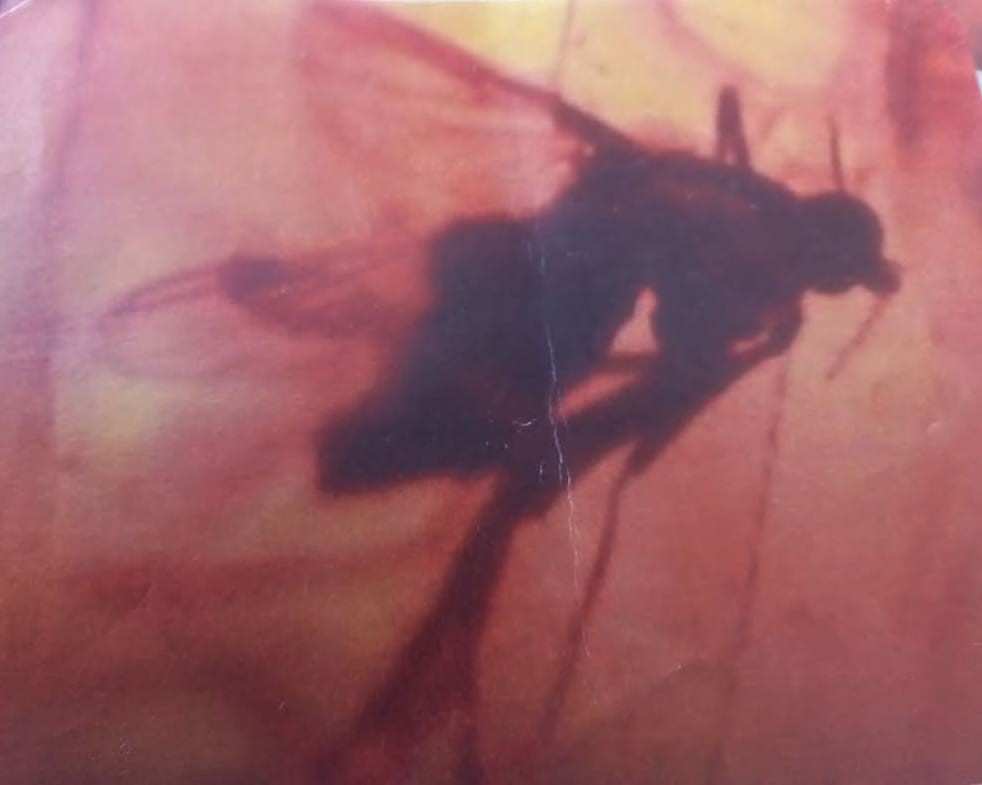
The studied specimen clearly shows a small insect entangled within a silky filament, believed to be part of an ancient spider web. This finding provides direct evidence that web-building behaviour in spiders was already developed during the Early Cretaceous period and that predator-prey relationships existed in a form comparable to those observed today.
The significance of this discovery can be summarized in several key scientific points:
First: It confirms that spider silk was already present and used for hunting at that early geological time.
Second: It provides insight into the biodiversity of the ancient resin-producing forests that formed Jordanian amber.
Third: It enhances the scientific importance of Jordanian amber as a valuable resource for studying behavioural ecology, not only morphological classification.
The preservation of the insect within a spider thread indicates that the resin flow was rapid enough to freeze this instantaneous event, offering a rare opportunity to observe a “living moment” from the distant past.
Such discoveries place Jordanian amber among the most significant amber deposits in the world and support research suggesting that the region hosted a rich and complex ecosystem during the Cretaceous period.
In conclusion, this trapped insect is not merely a fossil, but a living scientific testimony of an integrated ecological behavior and a precise interaction between organisms that lived millions of years ago, preserved with extraordinary detail to this day.
The picture is an insect trapped in a spider thread in Jordanian Amber
The studied specimen clearly shows a small insect entangled within a silky filament, believed to be part of an ancient spider web. This finding provides direct evidence that web-building behaviour in spiders was already developed during the Early Cretaceous period and that predator-prey relationships existed in a form comparable to those observed today.
The significance of this discovery can be summarized in several key scientific points:
First: It confirms that spider silk was already present and used for hunting at that early geological time.
Second: It provides insight into the biodiversity of the ancient resin-producing forests that formed Jordanian amber.
Third: It enhances the scientific importance of Jordanian amber as a valuable resource for studying behavioural ecology, not only morphological classification.
The preservation of the insect within a spider thread indicates that the resin flow was rapid enough to freeze this instantaneous event, offering a rare opportunity to observe a “living moment” from the distant past.
Such discoveries place Jordanian amber among the most significant amber deposits in the world and support research suggesting that the region hosted a rich and complex ecosystem during the Cretaceous period.
In conclusion, this trapped insect is not merely a fossil, but a living scientific testimony of an integrated ecological behavior and a precise interaction between organisms that lived millions of years ago, preserved with extraordinary detail to this day.
The picture is an insect trapped in a spider thread in Jordanian Amber
NEWS RELATED TO