

“Amrah City” A Necessary and Strategic Opportunity to Bridge Jordan’s Development Gaps
Ahmad M. Awad



The launch of the construction of the new “Amrah City”, after eight years of planning constitutes a strategic and pivotal step in Jordan’s development direction. It is not merely an urban expansion project; rather, it is a comprehensive national initiative designed to address long-standing development gaps and place Jordan on a more balanced and effective path.اضافة اعلان
The city will be established in a vast, semi-marginalized geographic area that possesses natural and tourism assets that make it highly suitable for transformation into a vibrant urban center. The designated area is characterized by flat plains and wide-open spaces that allow for flexible, modern urban planning. It is also located near significant historical sites such as Qasr Amra and Qasr al-Kharana, in addition to the Azraq Oases, which hold high ecological and tourism value. These features uniquely position the new city to become a modern model that integrates cultural heritage with economic and environmental dimensions.
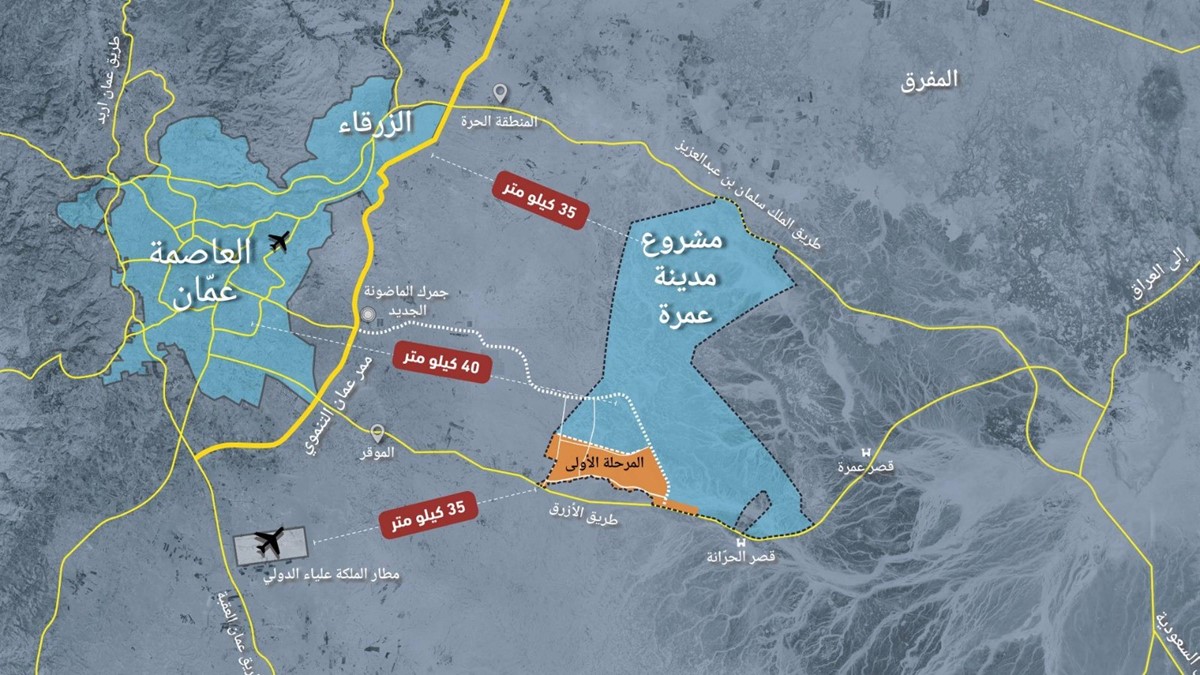
At the level of major cities, the new city is expected to ease the heavy pressure on Amman and Zarqa, both of which have reached saturated levels of congestion and infrastructure strain. Amrah City will provide a new space for urban expansion away from the overcrowded urban core, offering both Amman and Zarqa the chance to redefine their services and improve quality of life.
Beyond its broad economic significance, the project’s first phase will directly address development gaps that Jordan has long struggled with particularly the lack of integrated infrastructure for international exhibitions, major sports facilities, and cultural and recreational venues. For years, Jordan has lacked large, fully equipped complexes capable of hosting major economic, sporting, or cultural events, often depending on limited or unsuitable alternatives. Including such facilities in the first phase transforms the project into a national platform capable of attracting major events, stimulating service and tourism sectors, and enhancing Jordan’s economic and regional competitiveness.
Economically, the project is expected to refresh wide sectors, starting with construction and extending to services, transportation, trade, and light industries. Estimates indicate that the project could generate tens of thousands of direct and indirect jobs, placing it at the heart of national efforts to combat unemployment and stimulate economic growth.
The new city is a project for all Jordanians. Therefore, no one benefits from hindering or weakening it; on the contrary, it requires broad national support to ensure its success. While economic and financial challenges may arise, whether anticipated or unforeseen the state’s ownership of the land and core infrastructure will strengthen investor confidence, both locally and internationally, and open the door to wide-ranging development and service partnerships.
It is also essential to consider, from the beginning, the establishment of a rail link connecting Amman and Zarqa to the new city, serving as the backbone for the movement of workers, students, and visitors. An internal metro system would further ensure smooth mobility within the city, enabling it to become a truly future-ready urban center built on sustainable public transport and reduced reliance on private vehicles.
The new city represents a historic opportunity to reshape Jordan’s economic, urban, and cultural landscape. It is a first step toward bridging chronic development gaps and building a balanced future-oriented city, a national project worthy of full support.
The city will be established in a vast, semi-marginalized geographic area that possesses natural and tourism assets that make it highly suitable for transformation into a vibrant urban center. The designated area is characterized by flat plains and wide-open spaces that allow for flexible, modern urban planning. It is also located near significant historical sites such as Qasr Amra and Qasr al-Kharana, in addition to the Azraq Oases, which hold high ecological and tourism value. These features uniquely position the new city to become a modern model that integrates cultural heritage with economic and environmental dimensions.
At the level of major cities, the new city is expected to ease the heavy pressure on Amman and Zarqa, both of which have reached saturated levels of congestion and infrastructure strain. Amrah City will provide a new space for urban expansion away from the overcrowded urban core, offering both Amman and Zarqa the chance to redefine their services and improve quality of life.
Beyond its broad economic significance, the project’s first phase will directly address development gaps that Jordan has long struggled with particularly the lack of integrated infrastructure for international exhibitions, major sports facilities, and cultural and recreational venues. For years, Jordan has lacked large, fully equipped complexes capable of hosting major economic, sporting, or cultural events, often depending on limited or unsuitable alternatives. Including such facilities in the first phase transforms the project into a national platform capable of attracting major events, stimulating service and tourism sectors, and enhancing Jordan’s economic and regional competitiveness.
Economically, the project is expected to refresh wide sectors, starting with construction and extending to services, transportation, trade, and light industries. Estimates indicate that the project could generate tens of thousands of direct and indirect jobs, placing it at the heart of national efforts to combat unemployment and stimulate economic growth.
The new city is a project for all Jordanians. Therefore, no one benefits from hindering or weakening it; on the contrary, it requires broad national support to ensure its success. While economic and financial challenges may arise, whether anticipated or unforeseen the state’s ownership of the land and core infrastructure will strengthen investor confidence, both locally and internationally, and open the door to wide-ranging development and service partnerships.
It is also essential to consider, from the beginning, the establishment of a rail link connecting Amman and Zarqa to the new city, serving as the backbone for the movement of workers, students, and visitors. An internal metro system would further ensure smooth mobility within the city, enabling it to become a truly future-ready urban center built on sustainable public transport and reduced reliance on private vehicles.
The new city represents a historic opportunity to reshape Jordan’s economic, urban, and cultural landscape. It is a first step toward bridging chronic development gaps and building a balanced future-oriented city, a national project worthy of full support.
NEWS RELATED TO