

Sharif Hussein bin Ali Mosque in Aqaba: An Architectural Icon and Spiritual Beacon


The Sharif Hussein bin Ali Mosque holds an exceptional place in the religious and social memory of Aqaba. It has become one of the city's most prominent civilized landmarks, blending the aesthetic beauty of Islamic architecture with the spirituality of the site—particularly during the Holy Month of Ramadan, as it draws worshippers and visitors from across Jordan and abroad.اضافة اعلان
The Mosque’s Imam, Sheikh Haitham Janoon, stated that the mosque is the largest and most frequented in the governorate, with a capacity of approximately 3,500 worshippers, making it a towering religious lighthouse in the heart of the coastal city.
Historical Milestones
Sheikh Janoon outlined the mosque’s history, noting that the foundation stone was laid in 1975, and construction was completed in 1983 under the patronage of the late King Hussein bin Talal.
The mosque underwent a qualitative leap during the reign of His Majesty King Abdullah II, undergoing comprehensive rebuilding and rehabilitation starting in 2009 and reopening in 2011. His Majesty’s frequent visits to pray at the mosque reflect its profound religious and national significance.
Architectural Style and Religious Tourism
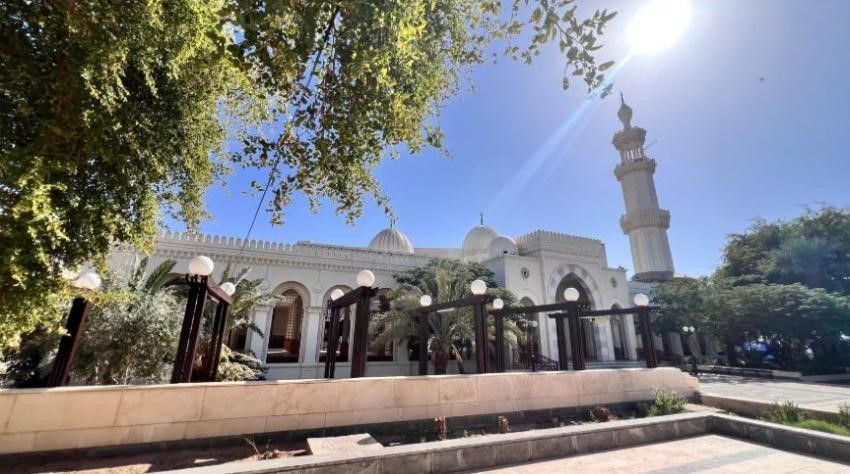
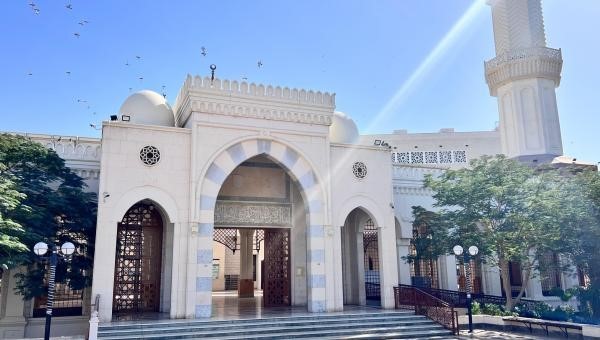
Regarding its design, Sheikh Janoon explained that the mosque’s architecture was inspired by the Mamluk style and the Prophet’s Mosque (Al-Masjid an-Nabawi) in Medina. Its striking white domes and towering minarets grant it a unique character that merges authenticity with elegance.
Located centrally overlooking King Hussein Street (The Corniche), the mosque has become a primary destination for religious tourism. It welcomes tourist delegations of various nationalities, providing modest clothing for female foreign visitors to introduce them to the tolerance and humanitarian values of Islam.
Natural Heritage and Maintenance
The mosque’s outer courtyard features ancient Sidr trees, some of which are over 110 years old. These trees are an integral part of the site’s natural heritage, providing shade and a historical atmosphere. Maintenance is conducted regularly, particularly for the nocturnal lighting system, through a partnership between the Ministry of Awqaf and the Aqaba Special Economic Zone Authority (ASEZA).
During Ramadan, the mosque buzzes with religious and social activities, including Taraweeh prayers, scientific circles, and celebrations for Laylat al-Qadr, remaining a living testament to Islamic civilization in Aqaba.
(Petra - Dina Mahadin)
The Mosque’s Imam, Sheikh Haitham Janoon, stated that the mosque is the largest and most frequented in the governorate, with a capacity of approximately 3,500 worshippers, making it a towering religious lighthouse in the heart of the coastal city.
Historical Milestones
Sheikh Janoon outlined the mosque’s history, noting that the foundation stone was laid in 1975, and construction was completed in 1983 under the patronage of the late King Hussein bin Talal.
The mosque underwent a qualitative leap during the reign of His Majesty King Abdullah II, undergoing comprehensive rebuilding and rehabilitation starting in 2009 and reopening in 2011. His Majesty’s frequent visits to pray at the mosque reflect its profound religious and national significance.
Architectural Style and Religious Tourism
Regarding its design, Sheikh Janoon explained that the mosque’s architecture was inspired by the Mamluk style and the Prophet’s Mosque (Al-Masjid an-Nabawi) in Medina. Its striking white domes and towering minarets grant it a unique character that merges authenticity with elegance.
Located centrally overlooking King Hussein Street (The Corniche), the mosque has become a primary destination for religious tourism. It welcomes tourist delegations of various nationalities, providing modest clothing for female foreign visitors to introduce them to the tolerance and humanitarian values of Islam.
Natural Heritage and Maintenance
The mosque’s outer courtyard features ancient Sidr trees, some of which are over 110 years old. These trees are an integral part of the site’s natural heritage, providing shade and a historical atmosphere. Maintenance is conducted regularly, particularly for the nocturnal lighting system, through a partnership between the Ministry of Awqaf and the Aqaba Special Economic Zone Authority (ASEZA).
During Ramadan, the mosque buzzes with religious and social activities, including Taraweeh prayers, scientific circles, and celebrations for Laylat al-Qadr, remaining a living testament to Islamic civilization in Aqaba.
(Petra - Dina Mahadin)
NEWS RELATED TO