

Jordanian Amber: An Anther and a Glimpse of an Ancient Forest
Dr . Abbas Haddadin



Jordanian amber, dating back approximately 140 million years to the Early Cretaceous, continues to reveal remarkable evidence of the plants and organisms that lived in the ancient environment of Jordan.اضافة اعلان
Among the specimens I have examined is a particularly interesting plant structure preserved inside Jordanian amber. The specimen appears to contain an anther-like structure, together with what may be a thin filament connecting it to the plant. Two additional fallen structures resembling anthers can also be observed in the specimen.
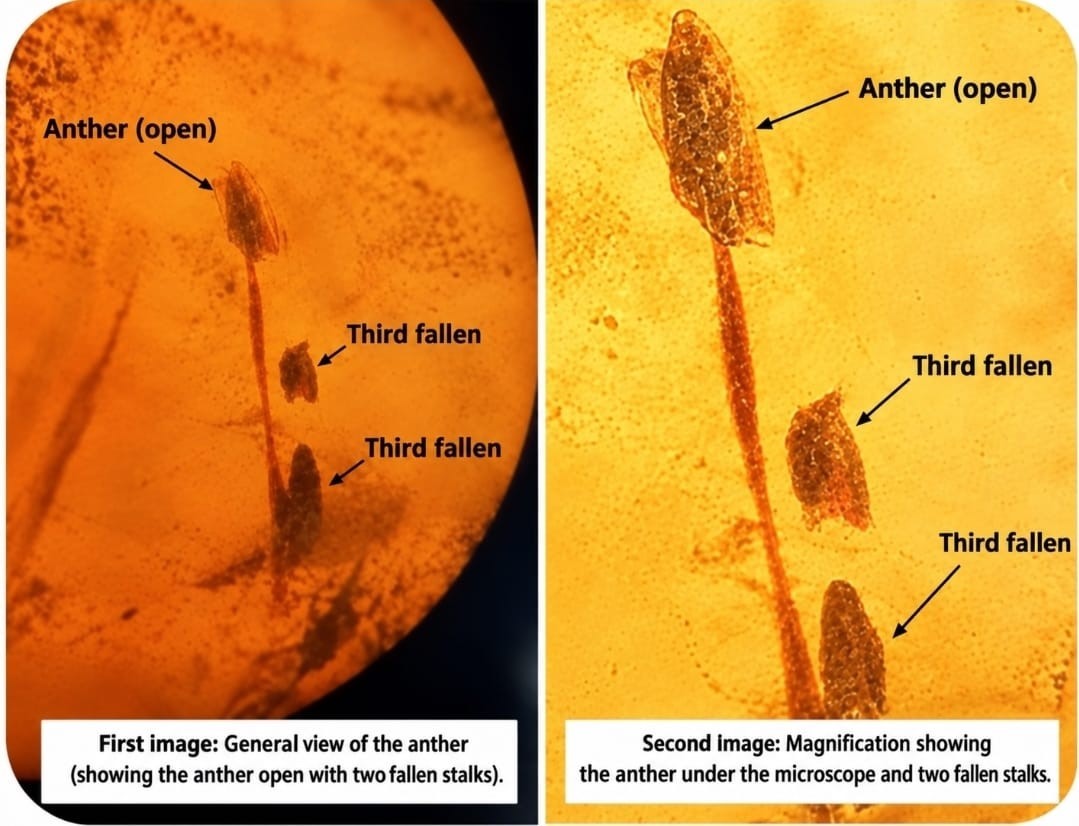
The main structure has a compact, elongated body at the end of a thin stalk-like structure. A small opening or exposed side is visible on the structure. These features are important because anthers are the parts of flowering plants that produce and release pollen.
However, I use the expression “possible anther” or “anther-like structure” rather than making a definitive identification. The final determination requires detailed microscopic and botanical examination by specialists. The observations presented here are based on the preserved specimen itself.
The discovery is especially interesting because I have documented approximately ten different types of fossil flower-like structures among the Jordanian amber material I have examined. Together, these plant remains provide evidence that the ancient environment was more botanically diverse than might be assumed from the insect fossils alone.
The possible anther is also significant because it may provide information about the reproductive structures of plants living in the region approximately 140 million years ago. If pollen can be confirmed in association with the structure, it could provide additional information about the plants that formed part of the ancient forest ecosystem.
Jordanian amber is therefore much more than a material that preserves insects. It can preserve fragments of an entire ancient ecosystem—plants, flowers, insects and other organisms—allowing researchers to study interactions between organisms that lived millions of years ago.
My observations of this specimen are part of a continuing effort to document the Jordanian amber collection. Each specimen requires careful examination, photography, comparison with modern plant structures, and reference to scientific literature before conclusions can be reached.
The possible anther represents another small but potentially valuable piece of evidence from the ancient world preserved in Jordanian amber. Further microscopic study may determine exactly what this remarkable structure was and what it can tell us about the vegetation of Jordan approximately 140 million years ago.
Among the specimens I have examined is a particularly interesting plant structure preserved inside Jordanian amber. The specimen appears to contain an anther-like structure, together with what may be a thin filament connecting it to the plant. Two additional fallen structures resembling anthers can also be observed in the specimen.
The main structure has a compact, elongated body at the end of a thin stalk-like structure. A small opening or exposed side is visible on the structure. These features are important because anthers are the parts of flowering plants that produce and release pollen.
However, I use the expression “possible anther” or “anther-like structure” rather than making a definitive identification. The final determination requires detailed microscopic and botanical examination by specialists. The observations presented here are based on the preserved specimen itself.
The discovery is especially interesting because I have documented approximately ten different types of fossil flower-like structures among the Jordanian amber material I have examined. Together, these plant remains provide evidence that the ancient environment was more botanically diverse than might be assumed from the insect fossils alone.
The possible anther is also significant because it may provide information about the reproductive structures of plants living in the region approximately 140 million years ago. If pollen can be confirmed in association with the structure, it could provide additional information about the plants that formed part of the ancient forest ecosystem.
Jordanian amber is therefore much more than a material that preserves insects. It can preserve fragments of an entire ancient ecosystem—plants, flowers, insects and other organisms—allowing researchers to study interactions between organisms that lived millions of years ago.
My observations of this specimen are part of a continuing effort to document the Jordanian amber collection. Each specimen requires careful examination, photography, comparison with modern plant structures, and reference to scientific literature before conclusions can be reached.
The possible anther represents another small but potentially valuable piece of evidence from the ancient world preserved in Jordanian amber. Further microscopic study may determine exactly what this remarkable structure was and what it can tell us about the vegetation of Jordan approximately 140 million years ago.
NEWS RELATED TO