

Seven Jordanian Creators Rediscover the Secrets of the Nabataeans


Petra is far more than a collection of façades carved into rock, or a rose-red city summed up by the image of the Treasury, known around the world. Behind its famous monuments lies a civilization that transformed the desert into a thriving center of life, trade and creativity, developing engineering, craftsmanship and artistic knowledge that left a lasting mark on the region’s history.اضافة اعلان
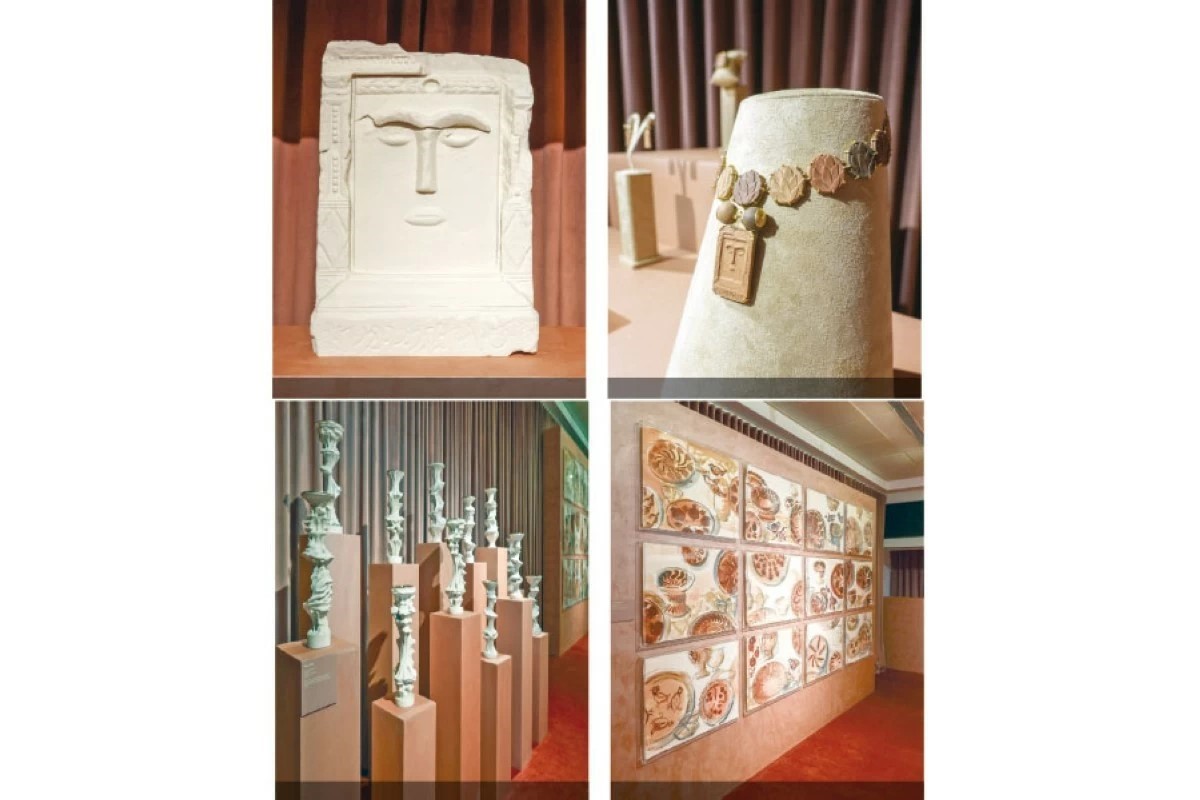
Inspired by this perspective, Jordan made a notable appearance at NOMAD Abu Dhabi 2026 through an artistic and design project titled “Petra: The Continuous Archive.” The project reintroduced Nabataean heritage through the work of seven Jordanian creatives and design projects, bringing historical research together with contemporary artistic experimentation.
Held at the Old Terminal Building of Abu Dhabi Airport from November 18 to 22, the exhibition presented Petra not merely as an archaeological site, but as a source of knowledge capable of inspiring artistic and design works rooted in the present and looking toward the future.
The project offered a fresh interpretation of Nabataean civilization, drawing on water management systems, pottery-making techniques, the incense trade, Nabataean writing, stone carving and jewellery-making. These areas of knowledge were transformed into artworks, furniture, jewellery, sculptures and visual experiences.
The project was conceived and produced by BADLÉ, led by its founder Haya Al-Maashar, who served as the project’s curator and producer, with Noor Al-Lawzi overseeing production. It was developed in cultural partnership with WUJŪD Art Foundation, with facilitation from the National Heritage Fund, formerly known as the National Association for the Preservation of Petra.
The significance of Jordan’s participation extends beyond showcasing local works at an international event. It presents a model for turning cultural heritage into a source of creativity while opening new opportunities for Jordanian designers to reach international audiences, institutions and markets.
Petra: A Civilization Built on Knowledge
In an exclusive interview, Haya Al-Maashar, founder of BADLÉ and curator and producer of “Petra: The Continuous Archive,” said the project was not intended to reproduce the familiar architectural image of the rose-red city, but rather to explore the knowledge that shaped its civilization.
“The world has become accustomed to seeing Petra through a single image: the Treasury. But behind that image lies an entire civilization of knowledge: engineers who managed water in the heart of the desert, potters who produced pottery as thin as eggshells, traders who connected caravan routes, and a writing system that evolved into the Arabic script we use today,” Al-Maashar said.
“Our question, therefore, was not what Petra looked like, but what Petra knew. We asked each designer to select a Nabataean knowledge system and reinterpret it in their own language,” she added.
This approach reflects the project's central philosophy: historical knowledge is not simply something to be displayed or documented. Instead, it becomes a starting point for creating new artistic forms that remain connected to the past without merely copying it.
Al-Maashar explained that Dina Haddadin transformed a Nabataean water channel into a passage for light, while Sama Al-Saket adapted ancient pottery techniques to create contemporary tiles using Jordanian clay. Mazen Al-Ali, meanwhile, reversed the traditional principle of sculpting through removal, using digital technologies to construct forms through addition.
She also highlighted the participation of architect and artist Ammar Khammash, whose career has been devoted to exploring Jordan’s landscape, nature and heritage. His work, “Eggshell,” translates the extraordinary delicacy of Nabataean pottery into the surface of a painting.
She described his participation as a link between a generation that established this body of knowledge and a younger generation now reshaping it.
Al-Maashar stressed that the project's message is that heritage is not something belonging exclusively to the past and preserved behind glass, but a living body of knowledge capable of evolving and taking on new forms.
“We wanted this story to be told from within, through Jordanian eyes. This became possible thanks to our cultural partnership with WUJŪD Art Foundation, which shares our belief that Jordanian creatives deserve to reach a global audience,” she said.
From Jordan to the World: Culture Beyond Borders
In a statement included in the project's official catalogue, Al-Maashar discussed the broader cultural vision behind the establishment of BADLÉ and the Ammari Archive, emphasizing her interest in how cultures travel and influence one another.
“I have always been fascinated by how culture moves: how ideas, crafts and aesthetics cross borders and find new forms. Petra is the clearest example of this that I know. BADLÉ and the Ammari Archive share the same purpose: to explore a culture deeply and give form and a future to what lives within it,” she said.
This vision reflects the project's approach to cultural identity, not as a fixed framework, but as something that can engage in dialogue with contemporary artistic practices and technologies.
BADLÉ works in cultural strategy, creative project development and collaboration between institutions, brands and artistic ecosystems. The Ammari Archive, meanwhile, focuses on drawing inspiration from memory, craftsmanship and culture in the design of jewellery and artistic objects.
A Partnership Opening Global Opportunities for Jordanian Creativity
WUJŪD Art Foundation served as the cultural partner for “Petra: The Continuous Archive,” in a collaboration highlighting the importance of institutional partnerships in supporting Jordanian creatives and creating new opportunities to showcase their work internationally.
Sireen Al-Masri, founder and chair of the foundation's board, said in a statement published in the official catalogue that the partnership reflects the foundation's commitment to supporting Jordanian creativity and expanding its international presence.
“Our cultural partnership with BADLÉ reflects WUJŪD's fundamental commitment to supporting Jordanian creatives and expanding their presence beyond our borders. At NOMAD Abu Dhabi, BADLÉ places Petra in a global conversation, and we are honoured to support this important milestone,” she said.
The foundation is based at Ayla Oasis on the Gulf of Aqaba and seeks to create an environment that brings together contemporary artistic experiences and cultural exchange, with a focus on interdisciplinary practices and empowering artists and creative communities.
The partnership is significant because it presents Jordanian creativity within an international context, giving local artistic experiences the opportunity to engage with wider audiences and strengthening Jordan's presence as a producer of culture and art, rather than solely as a destination known for its archaeological sites.
From the Siq to the Treasury: Space Becomes Part of the Story
The project's interpretation of Petra extended beyond the exhibited works to the design of the space that housed them inside the old airport terminal.
Kayn Studio, led by architect Dina Haddadin, designed the exhibition space, drawing inspiration from Petra's natural landscape, rock formations and the route through the Siq leading to the Treasury façade.
The layout allowed visitors to move between the artworks along a journey that evoked the distinctive character of the ancient city, making architectural design an integral part of the project's cultural narrative.
Al-Maashar said the pathway, which echoed the Siq and led toward the Treasury, turned the visit into an experience that visitors could live rather than simply observe.
This approach reflects the project's interest in presenting knowledge through sensory and visual experiences that connect the original location with contemporary forms of expression.
When a Nabataean Incense Burner Becomes a Digital Design
In his work “Serpents,” architect and designer Mazen Al-Ali drew inspiration from Nabataean incense burners associated with the ancient incense and frankincense trade. He presented 12 burners reflecting the symbolic significance of snakes in ancient beliefs.
Rather than reproducing archaeological objects, Al-Ali reimagined them using digital design techniques and 3D printing.
The forms were based on patterns inspired by nature, including wind erosion, sandstone formations and the branching shapes of valleys.
The work presents an intriguing artistic contrast: the Nabataeans carved their architecture by removing material from rock, while contemporary digital design builds forms by adding material layer by layer.
The result brings together two techniques separated by centuries but connected by a common idea: transforming material into a form that carries meaning and serves a purpose.
Excavating the Memory of Wool
In her work “Excavations,” artist Ishraq Zuraiqat used wool to evoke layers of the earth and archaeological memory.
She created a dense textile composition, then treated it through cutting, burning and exposing its internal layers, in a process that recalls archaeological excavation and the uncovering of what lies beneath the ground.
The work also draws on Nabataean architecture, which relied on carving rock and removing sections of material to achieve the desired form.
Through this treatment, wool is transformed from a soft material into a surface bearing traces resembling geological layers, creating a dialogue between the nature of the material and the idea of uncovering history.
Rather than presenting a direct representation of Petra, the work draws inspiration from the processes through which the city was formed and discovered, offering a reflective exploration of the relationship between people, place and memory.
From Water Engineering to the Engineering of Light
Architect and artist Dina Haddadin drew inspiration for her work “Channels of Light” from the engineering systems developed by the Nabataeans to manage and distribute water throughout Petra.
In a city located in a desert environment, the ability to collect, direct and store water was one of the main foundations of settlement and prosperity.
Haddadin reinterpreted this knowledge through sculptural lighting units made from Jordanian granite, incorporating channels and passages that allow light, rather than water, to flow through them.
The design preserves the original engineering principle of directing and controlling the flow of a resource, but transfers it to a new function within contemporary lighting and design.
The project demonstrates how ancient scientific knowledge can serve not merely as a subject of historical interest, but as a set of principles that can be adapted and reinvented.
Nabataean Pottery Precision Recreated on Canvas
In his work “Eggshell,” architect and artist Ammar Khammash revisited one of the most remarkable crafts associated with the Nabataeans: the production of exceptionally thin pottery.
Nabataean pottery was distinguished by its thin-walled vessels and delicate decoration, reflecting considerable technical and artistic development in ceramic production.
Through a series of 12 works on paper, Khammash used pigments and watercolours to reinterpret this craft, drawing inspiration from the delicacy of the material and the details of its decoration.
The distinctive feature of the work lies in its transition from pottery to painting, turning an ancient craft skill into a subject for visual reflection.
Khammash's participation also adds a deeper intellectual dimension to the project, drawing on his experience in studying Jordan's nature, architecture and heritage, while placing his work in dialogue with that of a new generation of designers.
Jordanian Clay Rediscovers Its Memory
Architect and ceramic artist Sama Al-Saket, founder of Hasweh Ceramics, presented “Material Imprints,” a work inspired by Nabataean pottery decoration and printing techniques.
Al-Saket used Jordanian clay to produce ceramic tiles forming the surface of a contemporary coffee table, reviving ancient shaping and decorative methods within a new functional design.
The work highlights the potential of local materials in creative industries and demonstrates how traditional craftsmanship can evolve into contemporary design products.
Its significance extends beyond the appearance of the table to the underlying concept: restoring recognition of Jordanian clay as a material carrying history and knowledge, capable of contributing to the creation of contemporary objects with a distinct cultural identity.
Hasweh Ceramics also contributed to producing the clay elements used in the “The Treasury” jewellery collection, reflecting the collaboration between crafts and artistic disciplines throughout the project.
Copper Flowers Tell the Story of Time
In her sculpture “Tender Stems,” artist Ria Qaysiyeh drew inspiration from Petra through botanical forms made of copper, evoking the city's connection to nature and its rose-red identity.
The sculpture uses roses and intertwined branches as a starting point for reflecting on beauty, fragility and transformation, drawing on the properties of copper, whose surface changes over time.
This transformation carries a meaning connected to the effects of time on materials and historic sites, making the work a reflection on memory and heritage preservation.
Rather than recreating a familiar archaeological façade, Qaysiyeh evokes Petra through its colour, natural environment and sensitivity to the passage of time.
Jewellery Inspired by Nabataean Symbols
In “The Treasury,” Haya Al-Maashar, through the Ammari Archive, presented a limited-edition jewellery collection inspired by Nabataean symbols and the stories associated with Petra's famous Treasury façade.
The collection includes a necklace, bracelet and earrings made from Jordanian clay and 18-karat gold, in collaboration with Hasweh Ceramics and M'sihem Jewellery, which produced the gold components.
The designs feature the face of the goddess Hayyan, alongside Nabataean inscriptions and decorative elements inspired by nature and ancient jewellery forms.
The collection draws on the popular story behind the Treasury's name, linked to the belief that gold was hidden inside the urn positioned above its façade.
However, the work reinterprets the meaning of treasure, suggesting that Petra's true wealth lies in the knowledge developed by the Nabataeans and the architecture, art, writing and beliefs they left behind.
The designs bring together clay, as a material connected to Jordanian land, and gold, traditionally associated with jewellery and precious possessions, creating contemporary pieces grounded in a clear cultural narrative.
Reference Models Connect Contemporary Art to Its Historical Roots
Alongside the artistic and design works, the project included five reference models inspired by Nabataean artefacts, produced using 3D printing in cooperation with the Department of Antiquities.
The models were produced by RUM Atelier and included an incense burner, a water pipe, an inscription in Nabataean script, the face of the goddess Hayyan and a delicate pottery cup.
Raneem Al-Kharouf contributed to preparing the details and carrying out the hand-finishing, while sculptor Tamara Al-Ali handled fabrication and finishing.
The importance of these models lies in allowing visitors to identify the original sources of inspiration behind the contemporary works.
They are interpretive models, not original archaeological artefacts, clarifying the relationship between heritage research and new artistic production.
In her comments, Al-Maashar said that displaying the models in cooperation with the Department of Antiquities allowed visitors to trace each contemporary work back to its original inspiration.
Jordanian Creativity in Front of an International Audience
Speaking about the importance of participating in NOMAD Abu Dhabi, Al-Maashar said the presence of seven Jordanian designers at the event placed Jordanian design on an international platform dedicated to collectible design, alongside global names and before collectors, curators and institutions from around the world.
“This opens up new markets and audiences for our designers and confirms that Jordan possesses the knowledge and talent needed to compete internationally,” she added.
She described the audience's response to the exhibition as particularly moving, noting that many visitors said they had previously known Petra mainly as a tourist destination before discovering, through the artworks, other dimensions of its civilization, knowledge and the people who shaped its history.
The experience allowed audiences to discover Petra from a different perspective, bringing together historical knowledge, art and design.
This response highlights the value of presenting major archaeological sites within new cultural contexts that allow audiences to explore beyond their familiar images while giving creative communities an opportunity to shape their contemporary narratives.
Ambitions for an Ongoing Project Inspired by Nabataean Knowledge
Al-Maashar revealed that the project's organizers hope to continue developing the experience, ensuring that its Abu Dhabi appearance does not remain a one-off event.
“We aspire for ‘Petra: The Continuous Archive’ to become an ongoing project, as its name suggests. With each edition, it will explore a new Nabataean knowledge system, celebrate Jordanian designers and eventually open its doors to designers from across the region and the world,” she said.
This vision creates opportunities to expand research into Nabataean heritage and produce new works inspired by other areas of knowledge developed in Petra.
It also offers the possibility of turning the project into a platform for collaboration among artists, designers, researchers, craftspeople and cultural institutions, strengthening its continuity and giving it a scope that extends beyond exhibitions.
The project received facilitation from the National Heritage Fund, chaired by HRH Princess Dana Firas, and support from several Jordanian entities, including the Jordan Tourism Board, Aramex, Royal Jordanian, the Department of Antiquities, Petra Development and Tourism Region Authority, Bank al Etihad and M'sihem Jewellery, among other supporters.
From Petra's Rocks to the World's Memory
Jordan's participation in NOMAD Abu Dhabi presents a different model for transforming cultural heritage into contemporary creative production, moving beyond the simple reproduction of familiar images and symbols.
Water channels became pathways for light, ancient incense burners evolved into digital designs, delicate pottery inspired paintings, and Jordanian clay was transformed into furniture and jewellery. Meanwhile, layers of rock and copper flowers became ways of reflecting on memory and time.
These works reveal the considerable potential of Jordanian creatives when given opportunities for research, experimentation and collaboration, and when local talent finds a path to international platforms.
They also reaffirm that the value of heritage lies not only in preserving its physical remains, but in understanding the knowledge that produced it and making that knowledge accessible to new generations so they can reinterpret and develop it.
Perhaps what makes this experience distinctive is that it does not present Petra as a city whose story ended centuries ago, but as an open source of questions and ideas to which artists and designers can return time and again.
NEWS RELATED TO